
68.1K
Downloads
336
Episodes
Join Renaud Anjoran, Founder & CEO of Sofeast, in this podcast aimed at importers who develop their own products as he discusses the hottest topics and shares actionable tips for manufacturing in China & Asia today!
WHO IS RENAUD?
Renaud is a French ISO 9001 & 14001 certified lead auditor, ASQ certified Quality Engineer and Quality Manager who has been working in the Chinese manufacturing industry since 2005. He is the founder of the Sofeast group that has over 200 staff globally and offers services (QA, product development & engineering, project management, Supply Chain Management, product compliance, reliability testing), contract manufacturing, and 3PL fulfillment for importers and businesses who develop their own products and buyers from China & SE Asia.
WHY LISTEN?
We‘ll discuss interesting topics for anyone who develops and sources their products from Asian suppliers and will share Renaud‘s decades of manufacturing experience, as well as inviting guests from the industry to get a different viewpoint. Our goal is to help you get better results and end up with suppliers and products that exceed your expectations!
Episodes
May 13, 2022
May 13, 2022
43 min
In this episode...
Our CEO Renaud is joined by a special guest in this episode, Andrew Hupert, a cross-cultural management and communication expert, coach, and trainer who spent 10+ years in China, is currently based in Mexico, and also creates a podcast you should check out: Globalism 2.0.
They discuss why companies are starting to leave China, in particular, American companies, where they're going, and why Western companies need to start thinking about diversifying supply chains rather than focusing on China alone. Andrew also gives some helpful insight into the business environment of Mexico and why it is a candidate for near-shoring supply chains for some American and Canadian companies.
Show Sections
00:00 - Greetings & Introduction to today's topic.
03:04 - Andrew's background.
04:21 - What is 'Globalism 2.0?'
13:29 - What is a bad scenario in the next few years that companies who manufacture products in China for sale in the USA need to plan for?
21:59 - Is there a timetable where the situation between China and the US becomes very hard for importers?
22:57 - Implementing China +1 and going further.
26:27 - Is Vietnam a potential China alternative?
29:56 - Have a lot of companies selling into the USA & Canada already near-shored their supply chains into Mexico?
33:15 - What's the relationship between Mexico and China?
40:22 - Wrapping up.
Related content...
- Read Andrew's book: The Fragile Bridge: Conflict Management in Chinese Business
- Follow Andrew on LinkedIn to read his latest posts
- Listen to Andrew's podcast, Globalism 2.0
- Why Your Product’s Final Assembly Should Be Close To Its Key Components
- When Should American Companies Reshore Manufacturing Or Stay In China?
- How To Diversify Manufacturing Sources Out of China and Cut Risk
- Nearshoring To Mexico. An Alternative To China? [Podcast]
Get in touch with us
- Connect with us on LinkedIn
- Send us a tweet @sofeast
- Prefer Facebook? Check us out on FB
- Contact us via Sofeast's contact page
- Subscribe to our YouTube channel
Subscribe to the podcast
There are more episodes to come, so remember to subscribe! You can do so in your favorite podcast apps here and don't forget to give us a 5-star rating, please:
- Apple Podcasts
- Spotify
- Stitcher
- Google Podcasts
- TuneIn
- Amazon Podcasts
- Deezer
- iHeartRADIO
- PlayerFM
- Listen Notes
- Podcast Addict
Get in touch with us
-
- Connect with us on LinkedIn
- Contact us via Sofeast's contact page
- Subscribe to our YouTube channel
- Prefer Facebook? Check us out on FB
May 6, 2022
May 6, 2022
36 min
In this episode...
Renaud answers 3 great questions that came in from our listeners, assisted by Adrian from the Sofeast team.
He'll cover how to communicate fabric quality to suppliers, tactics for coping with US tariffs on China-made goods, and strategies to cope with volatile material costs today.
Show Sections
00:00 - Greetings & Introduction
01:43 - "How to communicate the quality of materials/fabrics you want to buy to your supplier..? There are qualitative aspects that are outside a fabric spec description."
13:02 - How to minimize tariffs on China-made goods imported to the USA under our brand?
24:58 - Any tactics for handling volatile material and shipping costs today?
32:03 - Is China as affected by energy cost rises as other regions right now?
34:32 - Wrapping up.
Related content...
- Plastic, Silicone, Steel, and Others: Updated China Raw Materials Costs (Late Feb ’22)
- Rising Raw Material Prices: What Strategy To Follow? (6 Approaches)
- How To Cooperate With Your Chinese Supplier, Part 16: Bad News from China, Raw Material Prices Just Increased!
- How To Switch To A Newer, Better Chinese Manufacturer? [eBook]
Get in touch with us
- Connect with us on LinkedIn
- Send us a tweet @sofeast
- Prefer Facebook? Check us out on FB
- Contact us via Sofeast's contact page
- Subscribe to our YouTube channel
Subscribe to the podcast
There are more episodes to come, so remember to subscribe! You can do so in your favorite podcast apps here and don't forget to give us a 5-star rating, please:
- Apple Podcasts
- Spotify
- Stitcher
- Google Podcasts
- TuneIn
- Amazon Podcasts
- Deezer
- iHeartRADIO
- PlayerFM
- Listen Notes
- Podcast Addict
Get in touch with us
-
- Connect with us on LinkedIn
- Contact us via Sofeast's contact page
- Subscribe to our YouTube channel
- Prefer Facebook? Check us out on FB
Apr 29, 2022
Apr 29, 2022
43 min
In this episode...
In order for your manufacturer to truly understand what you expect from them a quality standard for your product is required. This lays out how the product should look, its components and materials, what defects are and aren't acceptable (if any), its color, and so many other important aspects that Renaud will go into here.
There are different levels of quality standards, from most basic to advanced...you'll see how they all fit together to keep everyone aligned and reduce quality problems from the start of your cooperation with the supplier.
Show Sections
00:00 - Greetings & Introduction
01:03 - What are quality standards?
07:51 - Does every importer implement a clear standard?
10:41 - 1. The golden sample.
16:20 - 2. Specifications sheet.
27:13 - 3. Defect board.
29:23 - 4. Boundary samples.
34:37 - How to handle and keep physical samples safe?
38:19 - Avoiding different conclusions being drawn during inspections by confirming the measurement system to be used, etc.
41:57 - Wrapping up.
Related content...
- Product specifications template for importers in China [FREE download]
- Documenting Your Company’s Quality Standard into the Details
- Is your China factory’s quality standard too low?
- Golden Sample: Why You Need It Before Mass Production Starts
- Why Is A Pre-Production Sample So Important? [Podcast]
- Quality Control Plan: Defining Expectations Before Production
- Product quality inspections in China/Asia [solutions from Sofeast]
Get in touch with us
- Connect with us on LinkedIn
- Send us a tweet @sofeast
- Prefer Facebook? Check us out on FB
- Contact us via Sofeast's contact page
- Subscribe to our YouTube channel
Subscribe to the podcast
There are more episodes to come, so remember to subscribe! You can do so in your favorite podcast apps here and don't forget to give us a 5-star rating, please:
- Apple Podcasts
- Spotify
- Stitcher
- Google Podcasts
- TuneIn
- Amazon Podcasts
- Deezer
- iHeartRADIO
- PlayerFM
- Listen Notes
- Podcast Addict
Get in touch with us
-
- Connect with us on LinkedIn
- Contact us via Sofeast's contact page
- Subscribe to our YouTube channel
- Prefer Facebook? Check us out on FB
Apr 22, 2022
Apr 22, 2022
42 min
In this episode...
A few episodes ago we put a call out to listeners for questions about manufacturing, especially in China, that they'd like Sofeast's CEO Renaud Anjoran to answer.
One particularly good question that would require too long an answer for just one section of an episode was:
What checklist of activities does an importer need to perform when ending business relationships with a Chinese contract manufacturer?
So, in this episode, Renaud takes you through what happens if you decide to leave your Chinese supplier, including reasons why you'd need to, how to manage the process, and some of the typical actions that need to be taken (in a kind of checklist).
Show Sections
00:00 - Greetings & Introduction
01:47 - Why can starting the process to leave your Chinese supplier be tricky?
06:29 - Reasons why you might decide to leave a supplier.
19:49 - Why the difficulty of doing business with Chinese suppliers these days may force some businesses to move away from even good suppliers.
21:26 - How to manage the process of moving production out of one factory in China to another?
27:31 - How to onboard your new manufacturer?
30:09 - What to do about your tooling?
36:21 - Lying to a supplier to ease a move. Yes, or no?
38:39 - What activities should we plan to do when transferring production from one supplier to a new one?
40:57 - Wrapping up.
Related content...
- 7 Reasons To Switch To A New Chinese Manufacturer
- Tips to Manage the Transfer of Production To Another Chinese Factory
- How To Plan for Transferring Production To a New Factory: 45 Point Checklist
- Get help to find a good manufacturer in China with this free eBook
- When a relationship turns sour with a Chinese supplier
- How To Switch To A Newer, Better Chinese Manufacturer? [eBook]
Get in touch with us
- Connect with us on LinkedIn
- Send us a tweet @sofeast
- Prefer Facebook? Check us out on FB
- Contact us via Sofeast's contact page
- Subscribe to our YouTube channel
Subscribe to the podcast
There are more episodes to come, so remember to subscribe! You can do so in your favorite podcast apps here and don't forget to give us a 5-star rating, please:
- Apple Podcasts
- Spotify
- Stitcher
- Google Podcasts
- TuneIn
- Amazon Podcasts
- Deezer
- iHeartRADIO
- PlayerFM
- Listen Notes
- Podcast Addict
Get in touch with us
-
- Connect with us on LinkedIn
- Contact us via Sofeast's contact page
- Subscribe to our YouTube channel
- Prefer Facebook? Check us out on FB
Apr 15, 2022
Apr 15, 2022
44 min
In this episode...
Many importers are new to sourcing from China so we've been creating a mini-series of episodes that explores the sourcing process with advice and best practices from Sofeast's CEO Renaud Anjoran.
In this series of episodes, we’re exploring how to do your own sourcing from China, from finding suppliers for your products to getting them made.
Last time in episode 98 we discussed how to follow up on ongoing production and what it means to be a hands-on or hands-off buyer, and continuing on with soft skills like this we’re now at the point where we’re working with a supplier who’s doing our manufacturing for us in China (or elsewhere in Asia), and the question is: how to develop them for better performance and results, and what sort of results should we be aiming for? This is where implementing a development program comes into it!
Show Sections
00:00 - Greetings & Introduction
02:20 - What is supplier development and is it overlooked by buyers?
Next, we'll go into what a supplier development program includes:
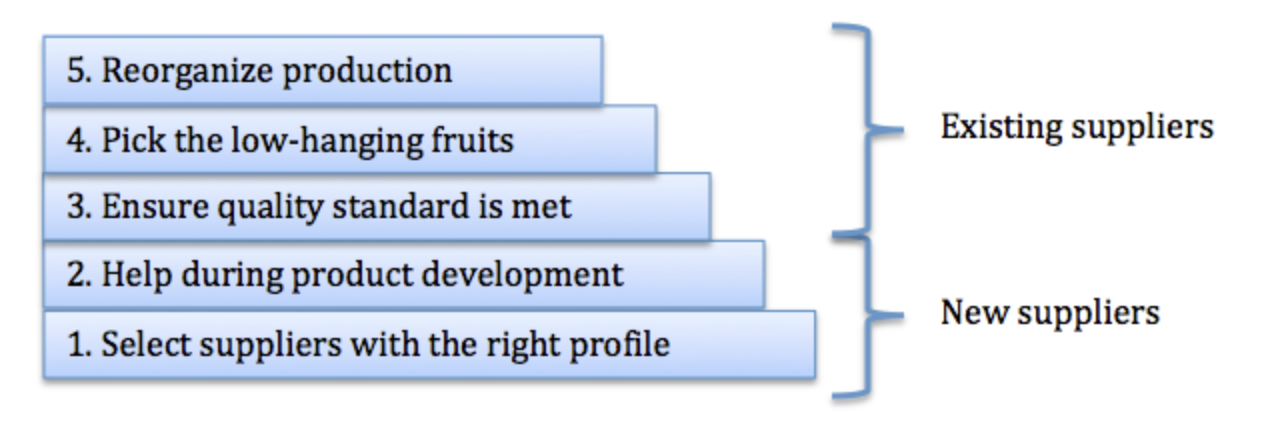
08:36 - 1. Selecting suppliers with the right profile.
12:43 - 2. Helping the supplier during product development and new productions.
17:09 - How phases 1 & 2 are connected to being a hands-on buyer and building rapport with the supplier.
18:44 - 3. Ensure your quality standard is met.
27:34 - Proactive approaches. 4. Targeting low-hanging fruits (small projects for quick wins).
33:05 - 5. Reorganizing manufacturing and/or supply chain processes.
38:51 - Summarizing what a supplier development plan is.
40:46 - When is supplier development worthwhile over switching suppliers and starting again?
41:45 - Why we started our own contract manufacturing subsidiary to embody the best practices discussed here.
43:21 - Wrapping up.
Related content...
- Part 1: Good Fit, Sourcing, Vetting, & Backups [Podcast]
- Part 2: Negotiations, Terms, Leverage, & Quality Standards [Podcast]
- Part 3: Project Management & Checking Quality Early [Podcast]
- Part 4: Final Inspections [Podcast]
- Part 5: Building Rapport [Podcast]
- Part 6: Hands-on or hands-off buyer? [Podcast]
- Developing a Chinese Supplier
- The Sofeast group's own contract manufacturing subsidiary: Agilian Technology
These resources will also help you understand how to build relationships with suppliers or improve (or end) those that you already have:
- Get help to find a good manufacturer in China with this free eBook
- When a relationship turns sour with a Chinese supplier
And, if all else fails and you need to ditch your current supplier and switch to a new one...
Get in touch with us
- Connect with us on LinkedIn
- Send us a tweet @sofeast
- Prefer Facebook? Check us out on FB
- Contact us via Sofeast's contact page
- Subscribe to our YouTube channel
Subscribe to the podcast
There are more episodes to come, so remember to subscribe! You can do so in your favorite podcast apps here and don't forget to give us a 5-star rating, please:
- Apple Podcasts
- Spotify
- Stitcher
- Google Podcasts
- TuneIn
- Amazon Podcasts
- Deezer
- iHeartRADIO
- PlayerFM
- Listen Notes
- Podcast Addict
Get in touch with us
-
- Connect with us on LinkedIn
- Contact us via Sofeast's contact page
- Subscribe to our YouTube channel
- Prefer Facebook? Check us out on FB
Apr 8, 2022
Apr 8, 2022
36 min
In this episode...
Sofeast's CEO Renaud Anjoran is joined by Adrian from the team to explain how to set up a receiving quality inspection on incoming components or materials that will be used by your factory or manufacturer to produce your products.
We've all heard the saying: "Garbage in, garbage out." This principle applies to manufacturing. So by conducting a receiving quality inspection, we assure that the components going into our products reach our expectations and reduce the chances of quality and reliability issues occurring in the finished products.
Keep listening to understand what the inspection is and how to set it up...
Show Sections
00:00 - Greetings and introduction.
01:02 - Covid in China.
06:28 - What is a receiving quality inspection?
14:11 - Benefits a receiving inspection provides.
16:16 - Some observations about why receiving inspections are needed.
19:22 - How a receiving inspection is made up (5 parts).
21:55 - 1. How to define receiving inspection requirements?
23:59 - 2. How to focus on the most important criteria (most critical parts and the highest risk)?
26:39 - 3. What incoming inspection procedure to follow?
31:13 - 4. How to report the findings?
33:08 - 5. How to drive improvement in the supplier base?
35:41 - Wrapping up.
Related content...
- Product Inspection Solutions In China & Asia (from Sofeast)
- How A Material Review Board (MRB) Works & Why YOUR Factory Needs One
- How to set up a Receiving Inspection: Checklist, Procedure, Reporting form
- Use a Corrective Action Plan after a Failed Inspection
Get in touch with us
- Connect with us on LinkedIn
- Send us a tweet @sofeast
- Prefer Facebook? Check us out on FB
- Contact us via Sofeast's contact page
- Subscribe to our YouTube channel
Subscribe to the podcast
There are more episodes to come, so remember to subscribe! You can do so in your favorite podcast apps here and don't forget to give us a 5-star rating, please:
- Apple Podcasts
- Spotify
- Stitcher
- Google Podcasts
- TuneIn
- Amazon Podcasts
- Deezer
- iHeartRADIO
- PlayerFM
- Listen Notes
- Podcast Addict
Get in touch with us
-
- Connect with us on LinkedIn
- Contact us via Sofeast's contact page
- Subscribe to our YouTube channel
- Prefer Facebook? Check us out on FB
Apr 1, 2022
Apr 1, 2022
40 min
In this episode...
To celebrate our 100th episode Sofeast's CEO Renaud Anjoran takes questions from our listeners and answers as many as possible in this special episode.
100 episodes is an important milestone and we're so glad that listeners enjoy the podcast and find it helpful, so thanks for the kind comments in your emails!
Show Sections
00:00 - Greetings and introduction.
01:50 - Should importers be worried about Chinese supply chains in relation to the Russian invasion and its sanctions?
06:56 - What inspection level is needed for medical devices? (AQL limits).
10:19 - How to improve the quality of products being purchased from China? The bikes and office furniture we buy keep breaking!
18:13 - Any tactics to deal with volatile costs these days?
25:02 - How to work with Chinese suppliers without being ripped off?
30:10 - How can I be sure that the product quality is as expected if I'm not in China to supervise the order myself?
38:34 - Wrapping up.
Related content...
- The Impacts of Russia Sanctions on International Trade & Logistics
- What is the AQL (Acceptance Quality Limit)? An exhaustive guide
- Manufacturing Contract: Fear And Its Impact On Payment Terms
- Factory audits
- Product inspections
Get in touch with us
- Connect with us on LinkedIn
- Send us a tweet @sofeast
- Prefer Facebook? Check us out on FB
- Contact us via Sofeast's contact page
- Subscribe to our YouTube channel
Subscribe to the podcast
There are more episodes to come, so remember to subscribe! You can do so in your favorite podcast apps here and don't forget to give us a 5-star rating, please:
- Apple Podcasts
- Spotify
- Stitcher
- Google Podcasts
- TuneIn
- Amazon Podcasts
- Deezer
- iHeartRADIO
- PlayerFM
- Listen Notes
- Podcast Addict
Get in touch with us
-
- Connect with us on LinkedIn
- Contact us via Sofeast's contact page
- Subscribe to our YouTube channel
- Prefer Facebook? Check us out on FB
Mar 25, 2022
Mar 25, 2022
55 min
In this episode...
Sofeast's CEO Renaud Anjoran is joined once again by our reliability expert, Andrew Amirnovin, and this time they're giving an overview of 12 things that a company can optimize for when designing and developing a new product. These include 'Design for Manufacturing,' Design for Assembly,' and many more. So, what are the DfX principles, what are their benefits if adopted by designers, and which could be right for you to focus on? Keep listening...
Show Sections
00:00 - Greetings and introducing the topic of DfX.
02:30 - 1. Design for Short Development & Time to Market.
05:16 - 2. Design for Crowdfunding.
08:13 - 3. Design for Manufacturing (DFM).
10:29 - 4. Design for Assembly (DFA).
13:35 - DFM & DFA tips for product designers to keep in mind.
19:19 - The rise of modularization.
25:04 - 5. Design for Quality & 6. Design for Testing
32:37 - 7. Design for Packaging.
35:45 - 8. Design for Reliability
45:12 - 9. Design for Maintainability.
49:15 - 10. Design for Ease of use/Ergonomics.
49:35 - 11. Design for Fewer SKUs.
50:20 - 12. Design for Sustainability.
51:02 - Which DfX principles are crucial?
51:55 - How to implement DfX?
53:58 - Wrapping up.
Related content...
- The Design for X Approach: 12 Common Examples
- Design for Distribution (DFD)
- Design to Cost (DTC)
- Design for Manufacturing (DFM)
- Design for Quality (DFQ)
- Design For Sustainability
- Design For Crowdfunding (Kickstarter & Indiegogo)
- Design For Assembly (DFA)
- Design for Distribution: What Hardware Startups Need To Know
Get in touch with us
- Connect with us on LinkedIn
- Send us a tweet @sofeast
- Prefer Facebook? Check us out on FB
- Contact us via Sofeast's contact page
- Subscribe to our YouTube channel
Subscribe to the podcast
There are more episodes to come, so remember to subscribe! You can do so in your favorite podcast apps here and don't forget to give us a 5-star rating, please:
- Apple Podcasts
- Spotify
- Stitcher
- Google Podcasts
- TuneIn
- Amazon Podcasts
- Deezer
- iHeartRADIO
- PlayerFM
- Listen Notes
- Podcast Addict
Get in touch with us
-
- Connect with us on LinkedIn
- Contact us via Sofeast's contact page
- Subscribe to our YouTube channel
- Prefer Facebook? Check us out on FB
Mar 18, 2022
Mar 18, 2022
36 min
In this episode...
Many importers are new to sourcing from China so we've been creating a mini-series of episodes that explores the sourcing process with advice and best practices from Sofeast's CEO Renaud Anjoran.
In this series of episodes, we’re exploring how to do your own sourcing from China, from finding suppliers for your products to getting them made.
We’ve moved onto soft skills, and last time in episode 92 we spoke about building rapport with your suppliers. Now, we’re going to look at how closely to follow production - either closely as a hands-on buyer, or with more distance as a hands-off buyer. Either approach might benefit you, but it depends on a number of factors, such as product type, the volume of SKUs being purchased, whether or not you're developing a new product from scratch, and more.
Listen and decide if you'd be better served by being more hands-on or hands-off.
Show Sections
00:00 - Greetings & quick mention of Covid in China
01:42 - Introducing the topic: How closely to follow production?
02:41 - What is a hands-off buyer?
08:33 - Buyers who should be more hands-on, but aren't, and the risks they face
11:29 - What is the typical sourcing process for hands-off buyers?
17:59 - What is a hands-on buyer?
23:32 - Benefits of being hands-on.
30:06 - Is there a risk of the supplier taking advantage of long-term customers who're reliant on them?
35:10 - Wrapping up.
Related content...
- Part 1: Good Fit, Sourcing, Vetting, & Backups [Podcast]
- Part 2: Negotiations, Terms, Leverage, & Quality Standards [Podcast]
- Part 3: Project Management & Checking Quality Early [Podcast]
- Part 4: Final Inspections [Podcast]
- Part 5: Building Rapport [Podcast]
- New Importer from China? Beware the Credulous Foreigner Syndrome!
These resources will also help you understand how to build relationships with suppliers or improve (or end) those that you already have:
- Get help to find a good manufacturer in China with this free eBook
- When a relationship turns sour with a Chinese supplier
And, if all else fails and you need to ditch your current supplier and switch to a new one...
Get in touch with us
- Connect with us on LinkedIn
- Send us a tweet @sofeast
- Prefer Facebook? Check us out on FB
- Contact us via Sofeast's contact page
- Subscribe to our YouTube channel
Subscribe to the podcast
There are more episodes to come, so remember to subscribe! You can do so in your favorite podcast apps here and don't forget to give us a 5-star rating, please:
- Apple Podcasts
- Spotify
- Stitcher
- Google Podcasts
- TuneIn
- Amazon Podcasts
- Deezer
- iHeartRADIO
- PlayerFM
- Listen Notes
- Podcast Addict
Get in touch with us
-
- Connect with us on LinkedIn
- Contact us via Sofeast's contact page
- Subscribe to our YouTube channel
- Prefer Facebook? Check us out on FB
Mar 14, 2022
Mar 14, 2022
23 min
In this episode...
Renaud is back with a bonus episode about the Covid situation in China. Since our last episode, the situation has gotten a lot more serious and there are lockdowns all around China, including in some major manufacturing cities and provinces, including Guangdong, Hong Kong, Shanghai, and Changchun (to name but a few).
Until now supply chains probably haven't been affected so much, but now factories are being shuttered, staff are at home, and deliveries and shipments can't take place. Add this to the sanctions on Russia, and times are getting complicated.
Show Sections
00:00 - Introduction.
00:52 - The uncertain situation. Have the figures been accurate?
02:05 - Shenzhen has been locked down, here's what we know.
04:28 - Focus on South China (including Hong Kong)
08:08 - Can the government contain the outbreaks and what's the impact on manufacturing?
14:14 - Other areas and cities around China's North facing restrictions.
16:06 - How these lockdowns will impact importers, especially logistics.
21:34 - Ports in China and shipping are at particular risk of disruption by Covid cases.
22:37 - Wrapping up.
Related content...
Here are some related posts:
- The Impacts of Russia Sanctions on International Trade & Logistics
- China Massive Lockdowns (March 22): The Domino Effect In Full Force
- Supply Chain Risk Reduction Strategies [Presentation]
- How Blending Off-site & On-site QA Activities Helps You Reach Your Objectives
Get in touch with us
- Connect with us on LinkedIn
- Send us a tweet @sofeast
- Prefer Facebook? Check us out on FB
- Contact us via Sofeast's contact page
- Subscribe to our YouTube channel
Subscribe to the podcast
There are more episodes to come, so remember to subscribe! You can do so in your favorite podcast apps here and don't forget to give us a 5-star rating, please:
- Apple Podcasts
- Spotify
- Stitcher
- Google Podcasts
- TuneIn
- Amazon Podcasts
- Deezer
- iHeartRADIO
- PlayerFM
- Listen Notes
- Podcast Addict
Get in touch with us
-
- Connect with us on LinkedIn
- Contact us via Sofeast's contact page
- Subscribe to our YouTube channel
- Prefer Facebook? Check us out on FB